
Landaluce’s Miami breakthrough: ‘Everything’s coming together this week’
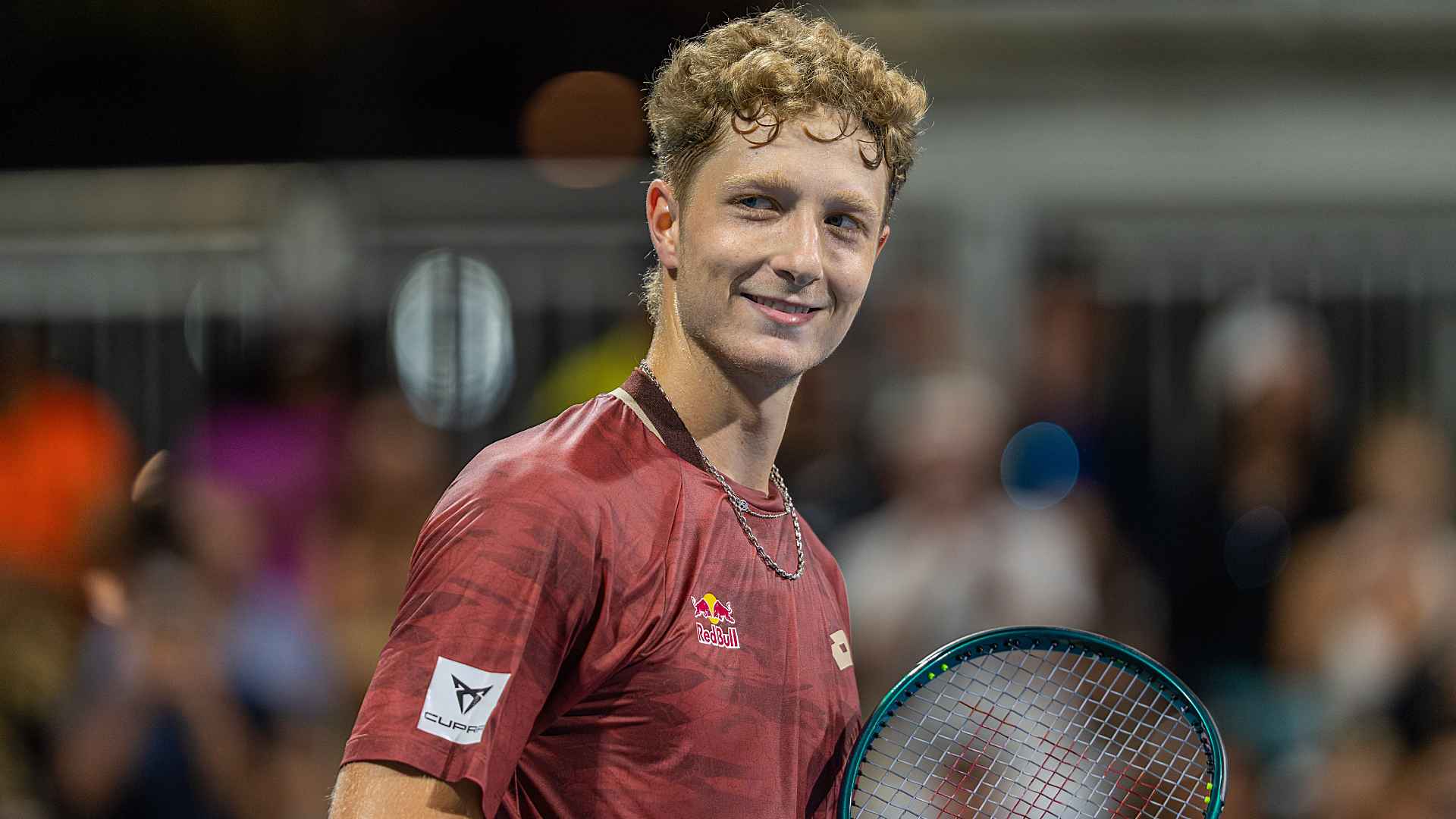
Martin Landaluce is enjoying a career-changing week in Miami. Not only because he has reached the quarter-finals of an ATP Masters 1000 at the age of 20, but because of the manner in which he has done so.
Landaluce came through two qualifying rounds to earn his place in the main draw and, once he got there, strung together three consecutive victories against Top-50 players, when his record against that group before arriving in Florida was 0-4.
“Doing it after qualies is hard to imagine, but I try to do it in every tournament. Here, the level is incredibly high in every round, it's very difficult,” Landaluce said. “Today I can be happy; parts of the match make me feel proud and allow me to think about the next one. The matches are so tough that thinking long term would be a mistake. Right now I'm thinking about the quarters and trying to make tomorrow a good match.”
The latest hurdle he cleared came on Tuesday in the form of Sebastian Korda, the man who had earlier sent Carlos Alcaraz packing. Landaluce earned his victory in the toughest way a young player can — starting badly, persevering, and winning when the cards are down. Landaluce lost the first set 2-6 and saved a match point in the second-set tie-break before eventually completing his comeback 2-6, 7-6(6), 6-4.
The theme that defined his match and, by extension his week, is one of composure under the greatest of pressure. In the second-set tie-break, with Korda one point away from taking the ‘W’, Landaluce held firm. He withstood the pressure, swung the momentum in his favour and stole the breaker. From there, the third set became a battle of energy and wits under Miami's beating sun. Korda called for medical assistance, but Landaluce was undeterred and eventually sealed his passage to the next round with the kind of determination that cannot be taught, only earned by surviving days like these.
The Spaniard offered a no-frills assessment of how he handled the situation: “I had a tricky moment at 5-4, serving for the match,” he said. “I don't think I did anything wrong, he played very well and, at such a high level if you drop off a little or the opponent does something better, the match gets complicated. It happened to me in the previous round against Tirante. It was a very tough match. The key to the tournament for me has been trusting myself, believing that at some point I can switch up a gear when I need to.”
His comeback against Korda was no flash in the pan either. It was the continuation of a trend that Landaluce is repeating this week as though it were a lifeline, competing without expecting any favours.
“When he broke me and started playing better, I knew I had to give my all. These are very good players and you have to go out to win. That gave me a lot of confidence for what came next,” Landaluce said. “Against Karen, I went out with the same mentality, and today was no different [against] a tough opponent who was outplaying me. You try to hang in there, keep fighting, trust yourself until your level improves a bit, and from there everything flows more. I'm happy that these early rounds, where sometimes you can bow out without having shown your true level, are going well here and that people can see how far I can go. It's a nice feeling.”
What stands out most, perhaps, is the context of his wins. Landaluce started the tournament ranked No. 151 in the PIF ATP Rankings and yet he is in the quarters, something historically rare in Miami. Moreover, he has become the first player born in 2006 to reach the quarter-finals at a tournament of this category.
Martín has endured a consistently challenging week. His breakthrough is by no means the result of a string of easy encounters, he has been on a mission from the start. Luciano Darderi was his first big encounter and it was a win that opened the door to the third round of a Masters 1000 for the first time. Next came Karen Khachanov, against whom Landaluce earned himself a debut in the Last 16 of a Masters 1000. His third big scalp was Korda, who was already in the limelight because of his win over Alcaraz and was playing with the home crowd behind him.
How does Landaluce explain these results? Consistency, routine and a determination not to lower his standards: “To do well every week and maintain a steady level, you have to repeat the same things,” Landaluce said. “I have very calm habits that help me do things normally every day. This week, in terms of improvements, both in practice and in matches, I haven't allowed myself to be passive or play below the level I need. I think that's essential against such tough opponents. Go after the match and trust yourself.”
Another consequence of all this, and one that would usually sound a little premature in March, is that Landaluce is on the brink of the Top 100 in the PIF ATP Rankings. At the same time, his week serves as a reminder of just how narrow the gap is between the Tours.
“The level in Challengers, and among the Top 100 or Top 150 players, is extremely high. That's why some players can take six months, a year or more to break through. The level is really strong,” Landaluce said. “When they get their chance at the top, they usually do well. In my case, everything is coming together this week and I hope it continues to do so. I think there's a tremendous level on all the Tours and we should support them, because they all contribute to weeks like this. We push each other and it's great to see everyone progressing.”
Some fans might not know that Landaluce is a multiple-time qualifier for the ATP Next Gen Accelerator, which provides additional playing opportunities for those who earn a spot in the programme by being the best up-and-coming players across junior, college or traditional pathways. Last year Landaluce used Next Gen Accelerator entries in an ATP 250 main draw (Gstaad), an ATP 250 qualifying draw (Marseille) and two ATP Challenger 125 main draws (Canberra and Birmingham). Earlier this year, he was able to enter Brisbane ATP 250 qualifying. Each of these entries was another chance for the Spaniard to gain experience leading to this moment in Miami.
There is the human side to this breakthrough, too. Landaluce dedicated the Korda win to his grandmother, who recently passed away.
After the match, the Madrid native also spoke about the people around him and the support that does not appear on the scoreboard but can lift a player when they are match point down in a tie-break.
“I speak with Carlitos and Rafa from time to time. I spoke with Rafa in Lled. We had a conversation that helped me a lot. I've seen Carlos some days,” Landaluce said. “They're both really nice people, always willing to support and help Spanish tennis grow. In these last rounds they haven't said anything to me, but I know they're there, I know they're happy with what I'm doing and I hope to keep crossing paths with them to learn as much as possible.”
Nadal himself evaluated what Landaluce achieved on Tuesday in Miami. “He has taken a step forward,” said the 22-time Grand Slam champion of the young player who trains at the Rafa Nadal Academy by Movistar. “I think he has some spectacular shots and he needs to keep improving some small things that will make a big difference.”
The next step is no longer simply to have “an extraordinary tournament”, but to battle for a place in a Masters 1000 semi-final. For someone who had an 0-4 record against Top 50 players before Miami, it is hard to put into words what a leap that would be.
